
River Birch Trees (Betula nigra)
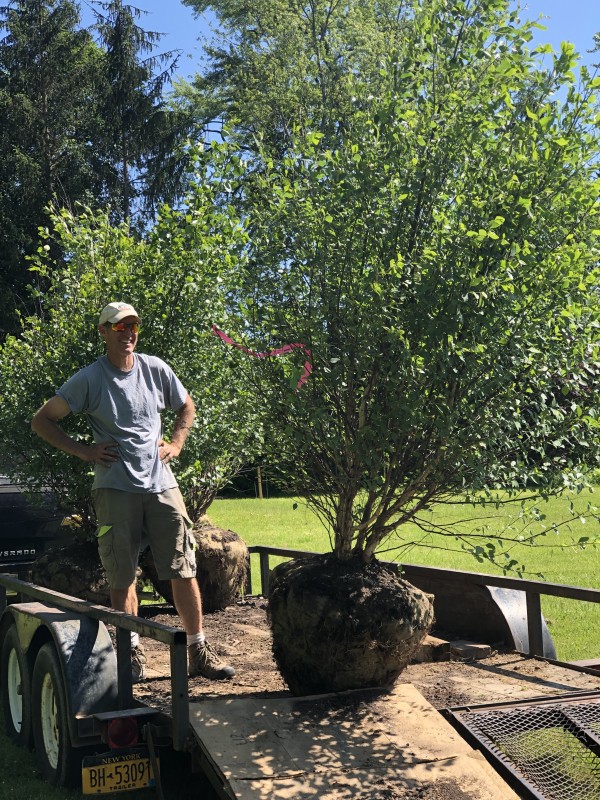
River Birch Trees (Betula nigra) are basically one of the great success stories of wet ground. They love saturated soils, seasonal flooding, rain gardens, streambanks, and wetlands, and they do not merely tolerate these conditions, they rather thrive in them. In landscapes shaped by water, River Birch feels inevitable, as if it has always belonged there.
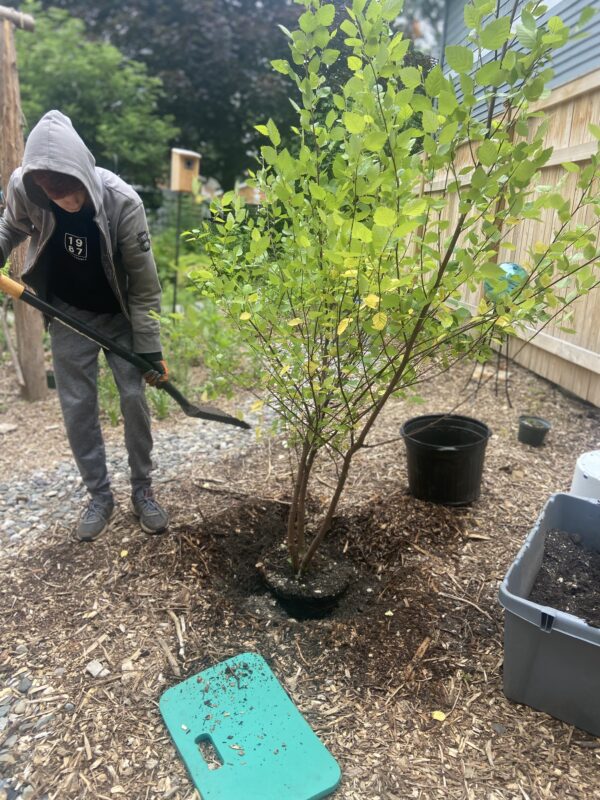
Fast Growing River Birch Trees.
This is a fast growing native tree of the Eastern United States, especially well suited to New York and the broader Northeast. It is often chosen for stormwater projects because it establishes quickly, stabilizes soil, and turns excess water from a liability into a defining feature of the landscape.
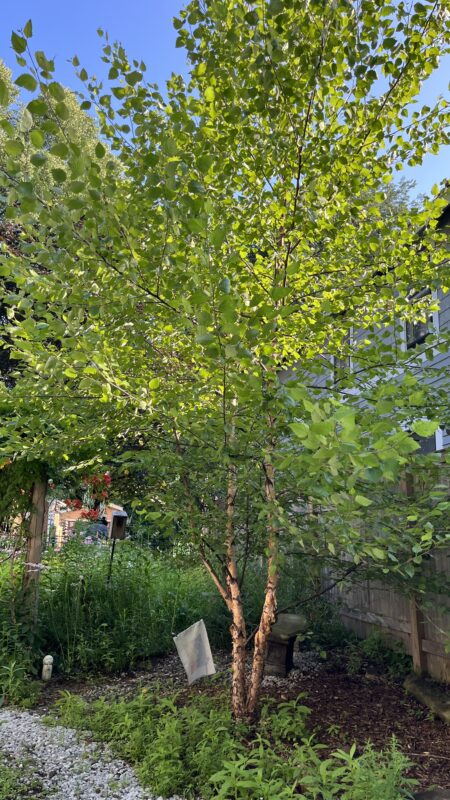
River Birch Trees + A Bark Built for Water.
One of the most beloved features of River Birch is its exfoliating, peeling bark. Cream, cinnamon, salmon, and gray tones curl and shed in papery layers, creating winter interest and texture that few trees can match. This peeling bark is not just beautiful, it is also adaptive.
In wet environments, bark that sheds helps prevent long term saturation, fungal buildup, and insect pressure. By regularly sloughing off outer layers, the tree stays healthier in places where constant moisture would challenge other species.
This same strategy appears again and again in floodplain and riparian trees. Shagbark Hickory (Carya ovata) sheds in long, dramatic plates. American Sycamore (Platanus occidentalis) exfoliates in puzzle-piece patches, revealing pale inner bark. River Birch belongs to this guild of trees shaped by water, disturbance, and renewal.
A Petite Presence With Big Impact… River Birch Trees♥️
Compared to massive canopy trees, River Birch is relatively petite and human-scaled. It often matures between 40 and 70 feet, frequently with multiple trunks and a graceful, slightly informal habit. This makes it especially well suited to residential landscapes, rain gardens near homes, and tight riparian corridors.
Its fine textured leaves flutter easily in the breeze, creating movement and light play. In summer, it casts dappled shade rather than deep darkness, allowing understory plants to persist beneath it. In winter, the bark becomes the star, glowing against snow and gray skies.

Rain Gardens, River Birch Trees, Wetlands, and Stormwater Systems.
River Birch Trees excel in rain gardens and bioretention areas where water pools after storms and drains slowly. Their root systems help absorb runoff, reduce erosion, and improve infiltration over time. In ecological landscaping, they often anchor the upper canopy layer of a wet meadow or stormwater basin, paired with shrubs like Red Osier Dogwood and perennials adapted to fluctuating moisture.
Unlike many ornamental trees that decline in wet soils, River Birch grows vigorously, often putting on several feet of growth per year when young. This speed makes it valuable in restoration projects where quick canopy cover is needed.
Forest Succession and Ecological Role.
In forest succession, River Birch is considered an early to mid successional species. It is quick to colonize disturbed ground such as floodplains, stream edges, and recently deposited soils. By establishing early, it stabilizes the site and creates conditions that allow longer lived, shade tolerant species to follow.
Its seeds feed birds, its foliage supports native insects, and its presence cools water and soil in riparian systems. Over time, River Birch often gives way to oaks, maples, and other climax species, but its role in the process is essential.
Taxonomy and Field Notes.
Betula nigra is the only birch native to the southeastern United States and the most heat tolerant of the birches. This trait explains its strong performance in exposed, sunny, and stressful sites where other birches struggle. Unlike Paper Birch (Betula papyrifera), which prefers cooler climates and well drained soils, River Birch is built for warmth, water, and movement.
In the field, look for its distinctive bark, alternate simple leaves with serrated edges, and its tendency to grow in clusters near water. If you see a birch thriving with its feet wet, it is almost always River Birch.
A Tree That Understands Water.
River Birch Trees are a reminder that good design begins with listening to the land. Where water flows, pools, and lingers, this tree steps forward with confidence. It brings beauty, resilience, and ecological intelligence to places shaped by rain and rivers, and it does so without pretense.
In rain gardens and wetlands, River Birch does not fight the conditions. It celebrates them.
Certainly, Jessecology will plant River Birch for you in New York! “Start Your Project” right now!
Suggested Products


